

- 製品一覧
-
ソリューション
- 技術
-
最新情報

ADATA Industrial to Participate in Embedded World 2026 Leading the New Era of AI-Driven Innovation
さらに詳しく
ADATA INDUSTRIAL Unveils AI and Edge Storage Innovations at Embedded World North America 2025
さらに詳しく
ADATA Industrial Releases DDR5 6400 CU-DIMM and CSO-DIMM - Empowering HPC with overclocking speed and extraordinary stability
さらに詳しく- サービス
- 会社情報
- サービス











Monthly Memory & Flash Market Watch
April 2024


Samsung and SK hynix showcased their upcoming GDDR7 memory solutions at NVIDIA GTC 2024
• Both displayed 16Gb (2GB) devices while JEDEC GDDR7 standard is finalizing. The chips would have been produced prior to the official standard and this has some implications for the next generation Nvidia Blackwell and AMD RDNA 4 GPUs.
Kioxia and WD Elevate Capacity Utilization to nearly 90%
• This is in hopes of returning to profitability with anticipation of NAND flash price hikes into 2Q24.
Kioxia sets sight on 218-layer capacity expansion by 2025 to lead in high-stack technology.
Process upgrades are essential for maintaining cost competitiveness with NAND flash prices are on the rise in 2024 amidst a gradual reduction in suppliers’ stock levels.
Kioxia’s strategy involves directly advancing to 300-layer and above processes after 218 layers to achieve a more favorable cost structure and regain technological and cost leadership.

Micron announced its fiscal 2Q24 financial results (ended Feb.’24)
• Revenue portion: DRAM:NAND=71%:29%
• The company expects to maintain its technology leadership in NAND. AI server demand is driving rapid growth in HBM, DDR5 and data center SSDs, which is tightening leading-edge supply availability for DRAM and NAND.

SUPPLY TREND
2023-2024 Worldwide SSD Shipment

WW SSD demand is expected to grow stably throughout 2024.
2023-2024 Worldwide DRAM Output

2023-2024 NAND Price Trend & Sufficiency Ratio
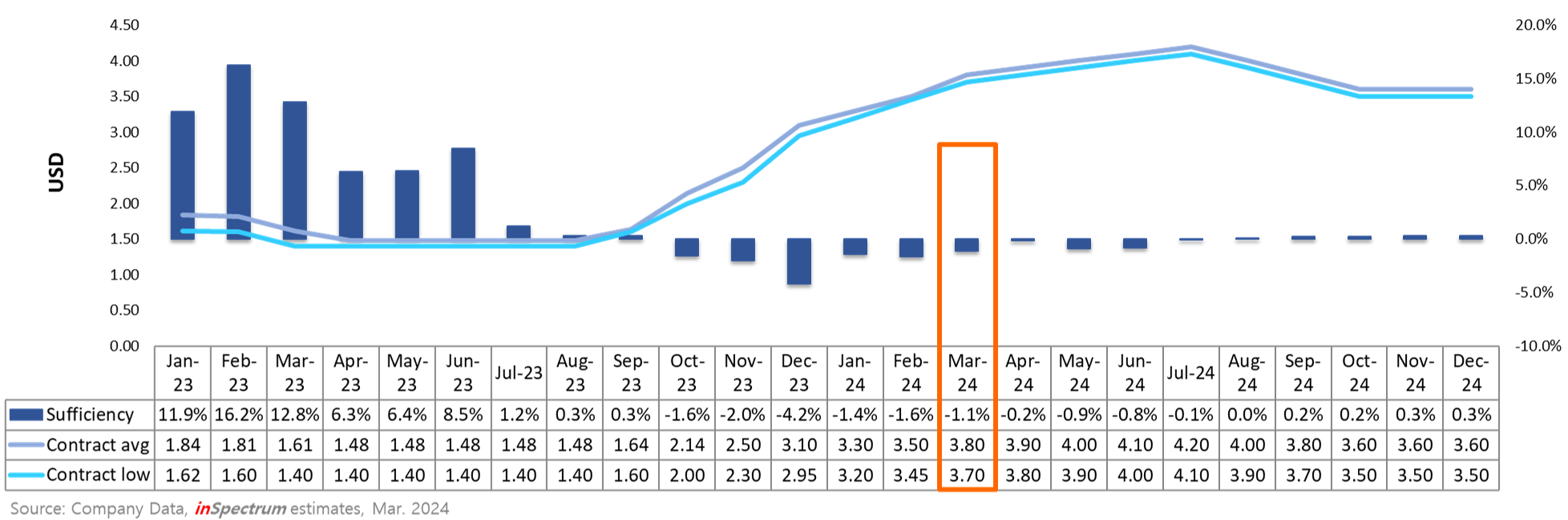
NAND Sufficiency: maintained at a low level since 2H23
Price Trend: NAND flash price is expected to climb continuously at least until 3Q24
2023-2024 DDR4 Price Trend & Sufficiency Ratio

DRAM Sufficiency: maintained at an extreme low level during 1Q-3Q24
Price Trend: 8Gb contract price increased obviously in Jan.’24. and will remain higher than the spot low trend in 2024
SUPPLY SIGNAL
| Type | Supply | Price | |
|---|---|---|---|
|
DRAM Module  |
DDR3 | ● | ▲ |
| DDR4 | ● | ▲ | |
| DDR5 | ● | ▲ | |
|
Flash Storage  |
SLC | ● | ▂ |
| MLC | ● | ▲ | |
|
3D TLC (BiCS3) *Limited Supply. We encourage you to migrate to BiCS4 and BiCS5 |
● | ▲ | |
| 3D TLC (BiCS4) | ● | ▲ | |
| 3D TLC (BiCS5) | ● | ▲ |
●Smooth Supply ● Mildly Tight Supply ● Tight supply ▂ Flat ▲ Upward trend ▼ Downward trend


インサイト
View all
How to Choose Server RAM:
Learn how to choose server RAM, including ECC, UDIMM vs. RDIMM, DDR4 vs. DDR5, memory capacity, platform compatibility, and industrial server applications.

ECC RAM vs. Non-ECC RAM:
Compare ECC RAM vs. Non-ECC RAM and learn how ECC Memory corrects memory errors, how DDR5 On-Die ECC differs from system-level ECC, what platform compatibility requirements to consider, and how to choose between ECC UDIMM, RDIMM, and SODIMM for medical, networking, NVR, Edge AI, and transportation applications.

What Is Signage Storage?
Signage Storage supports the local storage requirements of Digital Signage, POS, kiosks, and AI retail systems. Explore key SSD selection factors, including interface, capacity, endurance, operating temperature, PLP, S.M.A.R.T. monitoring, and fixed BOM.

高耐久SSD:実環境のワークロードにおけるTBWと製品寿命
TBW、DWPD、P/Eサイクル、pSLC、MLC、TLC、QLCが産業用SSDの耐久性にどのように影響するのかについて解説します。ADATA Industrialからサポートを得ながら、監視、サイバーセキュリティ、エッジワークロードに適したSSDを選定できます。

SSD SMARTデータを使用してドライブの健全性を監視する方法とは?
SSD SMARTデータには、ストレージデバイスの動作状態が継続的に記録されます。累積稼働時間、温度、書き込み量、耐久性の消費状況、利用可能な予備容量、予期しない電力損失の発生などの情報を提供します。

自動車用SSDとは?
自動車用SSDは、テレマティクス、鉄道用NVR、フリート管理、ADAS、路側エッジシステムなど、過酷な輸送環境で信頼性の高いストレージを実現するために設計されています。ADATAの産業グレードSSDは、-40°C~85°Cで動作し、AEC-Q100 Grade 3に相当する温度範囲をカバーしているため、多くの車載用途に適しています。