

-
Products
-
Solutions
-
Technology
Read moreProprietary Technologies
ADATA Industrial Team's Proprietary Technologies
 Read moreEndurance
Ultra-Long Lifecycles
Read moreSecurityIndustrial Data Security
Read moreData IntegrityFull-Link Verification
Read moreRuggednessDesigned for Harsh Environments
Read moreStabilityZero-Error Reliability
- What's New










Monthly Memory & Flash Market Watch
April 2024


Samsung and SK hynix showcased their upcoming GDDR7 memory solutions at NVIDIA GTC 2024
Both displayed 16Gb (2GB) devices while JEDEC GDDR7 standard is finalizing. The chips would have been produced prior to the official standard and this has some implications for the next generation Nvidia Blackwell and AMD RDNA 4 GPUs.
Kioxia and WD Elevate Capacity Utilization to nearly 90%
This is in hopes of returning to profitability with anticipation of NAND flash price hikes into 2Q24.
Kioxia sets sight on 218-layer capacity expansion by 2025 to lead in high-stack technology.
• Process upgrades are essential for maintaining cost competitiveness with NAND flash prices are on the rise in 2024 amidst a gradual reduction in suppliers’ stock levels.
• Kioxia’s strategy involves directly advancing to 300-layer and above processes after 218 layers to achieve a more favorable cost structure and regain technological and cost leadership.


Micron announced its fiscal 2Q24 financial results (ended Feb.’24)
• Revenue portion: DRAM:NAND=71%:29%
• The company expects to maintain its technology leadership in NAND. AI server demand is driving rapid growth in HBM, DDR5 and data center SSDs, which is tightening leading-edge supply availability for DRAM and NAND
SUPPLY TREND
2023-2024 Worldwide SSD Shipment

WW SSD demand is expected to grow stably throughout 2024.
2023-2024 Worldwide DRAM Output

2023-2024 NAND Price Trend & Sufficiency Ratio
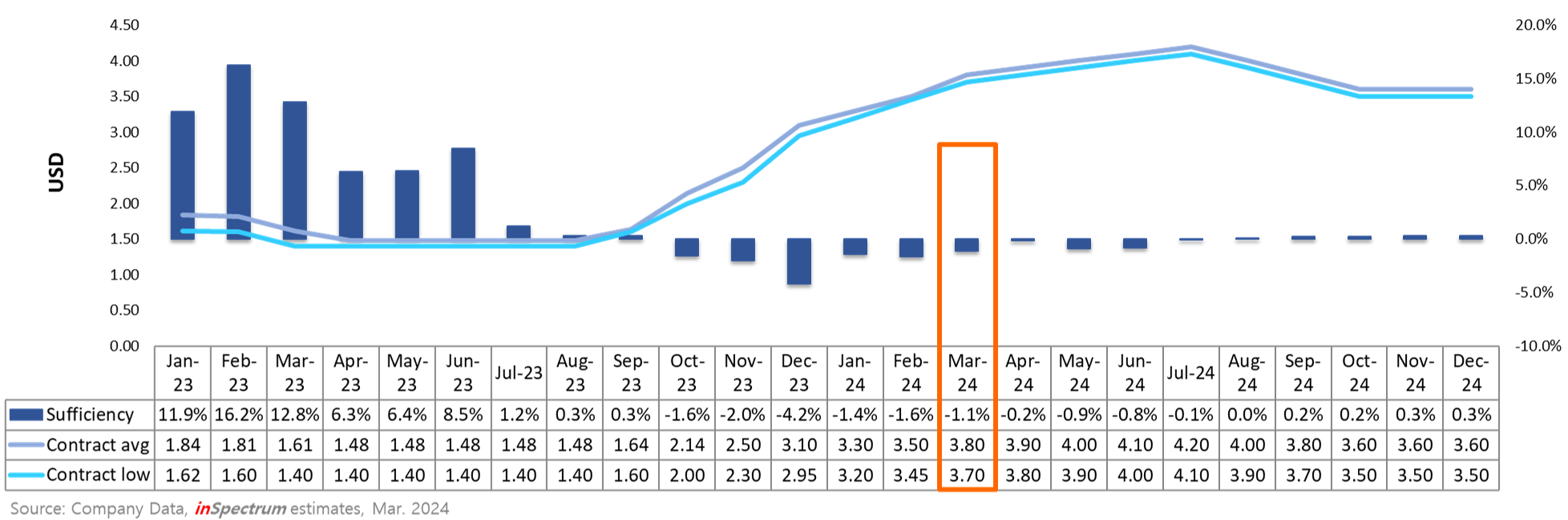
NAND Sufficiency: maintained at a low level since 2H23
Price Trend: NAND flash price is expected to climb continuously at least until 3Q24
2023-2024 DDR4 Price Trend & Sufficiency Ratio

DRAM Sufficiency: maintained at an extreme low level during 1Q-3Q24
Price Trend: 8Gb contract price increased obviously in Jan.’24. and will remain higher than the spot low trend in 2024
SUPPLY SIGNAL
| Type | Supply | Price | |
|---|---|---|---|
|
DRAM Module  |
DDR3 | ● | ▲ |
| DDR4 | ● | ▲ | |
| DDR5 | ● | ▲ | |
|
Flash Storage  |
SLC | ● | ▂ |
| MLC | ● | ▲ | |
|
3D TLC (BiCS3) *Limited Supply. We encourage you to migrate to BiCS4 and BiCS5 |
● | ▲ | |
| 3D TLC (BiCS4) | ● | ▲ | |
| 3D TLC (BiCS5) | ● | ▲ |
●Smooth Supply ● Mildly Tight Supply ● Tight supply ▂ Flat ▲ Upward trend ▼ Downward trend


Insights
View all
How to Choose Server RAM:
Learn how to choose server RAM, including ECC, UDIMM vs. RDIMM, DDR4 vs. DDR5, memory capacity, platform compatibility, and industrial server applications.

ECC RAM vs. Non-ECC RAM:
Compare ECC RAM vs. Non-ECC RAM and learn how ECC Memory corrects memory errors, how DDR5 On-Die ECC differs from system-level ECC, what platform compatibility requirements to consider, and how to choose between ECC UDIMM, RDIMM, and SODIMM for medical, networking, NVR, Edge AI, and transportation applications.

What Is Signage Storage?
Signage Storage supports the local storage requirements of Digital Signage, POS, kiosks, and AI retail systems. Explore key SSD selection factors, including interface, capacity, endurance, operating temperature, PLP, S.M.A.R.T. monitoring, and fixed BOM.

High-Endurance SSD: TBW and Service Life for Real-World Workloads
Learn how TBW, DWPD, P/E cycle, and pSLC, MLC, TLC, and QLC affect industrial SSD endurance. Choose the right SSD for surveillance, cybersecurity, and edge workloads with support from ADATA Industrial.

How to Use SSD SMART Data to Monitor Drive Health?
What is an automotive SSD? Learn how AEC-Q100 grades, IATF 16949, PLP, pSLC, encryption, and wide-temperature design affect SSD selection for in-vehicle and transportation systems.

What Is an Automotive SSD?
Learn how to select automotive SSD based on AEC-Q100 grades, IATF 16949, ISO/SAE 21434, PLP, and pSLC for in-vehicle, railway, and edge system.